

Every year, law enforcement personnel try to find new ways to do the job better. Looking for efficiency, cost-management, greater safety, and general effectiveness, they explore technologies and techniques that can aid them in daily activities and decisions.
Moving through 2025 and looking ahead, a number of law enforcement trends have emerged, showing promise in many positive areas including emergency vehicle technology. Here are some of the leaders among those trends.
1. AI and Digital Technology
As AI continues to push its way into more and more professions, law enforcement groups are finding ways to leverage the emerging technology.
Predictive modeling is one of the leading uses today. AI models can predict a number of trends in crime, policing, and general public behaviors. These models help police departments allocate resources more efficiently, and in the best cases, they can stem specific rises in crime before things escalate too far.
The challenge is that AI models require a lot of data, and that brings many changes to departments to accompany the rollout of AI.
For starters, departments and agencies need to collect more data. This can change practices all the way down to the investigation level. Where evidence may have previously been handled entirely offline, new techniques and systems digitize evidence to create large databases that can inform AI.
Yet, no one department can generate enough data to make truly robust AI modeling work, so departments are finding more ways to share data. With increased usage in cloud resources, data standardization, and new policies that make data sharing work, police forces are able to benefit from hard working departments around the country.
Lastly, big data applies to a lot more than crime trends or specific criminal evidence. It can impact training programs, scheduling, support staffing, equipment choices, and every other high-level decision made by a department.
2. Vehicle Upfitting
Major technology changes are reimagining police hardware and tools, and that might be most notable in police cruisers and vehicles.
Vehicle upfitting aims to improve many aspects of police vehicles. One of the rising law enforcement trends today is an increase in the usage of electric and hybrid vehicles.
EVs offer a few advantages for police vehicles in particular. As cruisers spend a very large amount of time at idle, the ability of EVs to idle at 0 RPM saves considerably on fuel and wear and tear.
EVs also offer more fuel efficiency and substantially lower maintenance costs, making them appealing to many police departments.
That said, EVs don’t always work in every work case, which is why hybrids are also popular. Hybrid vehicles can still idle at no RPM and offer EV advantages while allowing for faster fueling times and greater total range. They can also put out more power when police trucks have to do some heavy lifting.
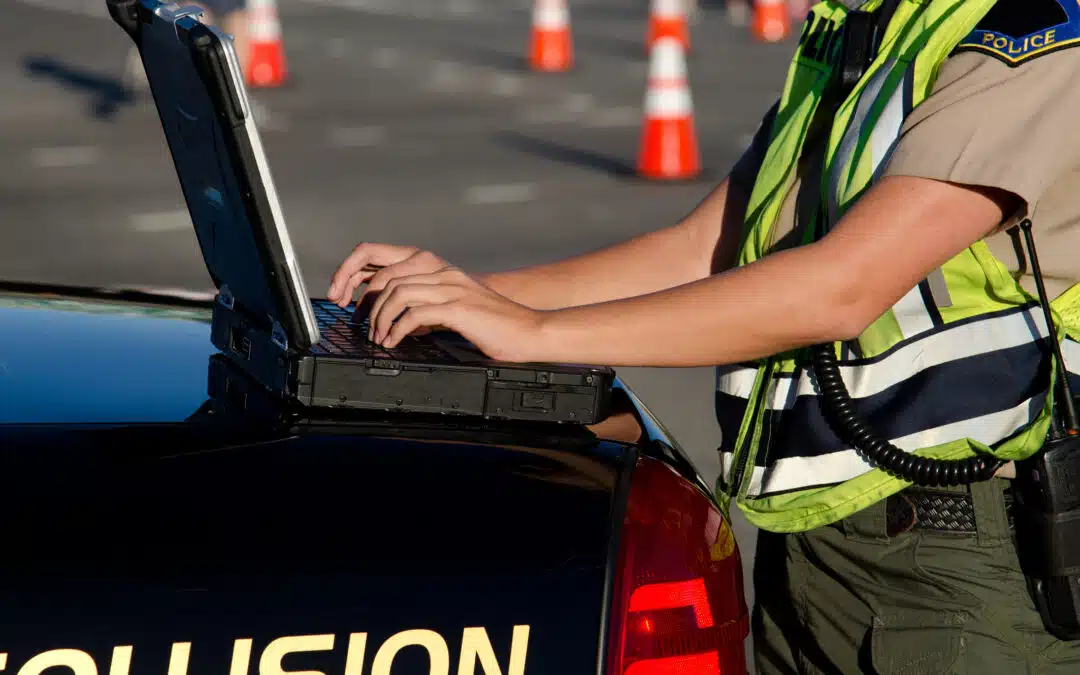
Above all of this, EVs and hybrids are gaining popularity for their ability to integrate with advanced electronic systems. Smart vehicles can predict maintenance schedules and repairs to minimize downtime. They also incorporate driver assistance and AI tools well. Additionally, advanced modular pieces, like in-vehicle police computers, tend to mesh well with these advanced vehicles.
In fact, the latest trend is the modular build. With this, vehicles can add or change electronic systems without the need to rewire the vehicle in significant ways. Often called “no-scar” modularity, manufacturers like Ford and GM are working to create cars and trucks designed with refitting in mind — specifically for police and emergency work.
As upfitting can range from simple additions to engine replacements, they offer any department the ability to improve everyday technology at a pace and budget that suits them.
3. Drones
Drones have seen some use in law enforcement for a while, but drone capabilities are exploding around the world. With better, cheaper, and more versatile drones available, paired with ever cleverer ways to use them, drones are becoming integral for law enforcement.
In the simplest cases, drones improve surveillance capabilities, allowing police to monitor situations while reducing physical risk.
Synchronized drones can observe large areas and share information with each other — all while using significantly less time and money than previous methods.
Modern drones can even dock with hardware in a police cruiser, keeping it charged and integrating with other tools for easier use and better controls. Combined with the modular approach to vehicular upfitting, drones can become hardworking elements of everyday law enforcement work.
4. Evidence-Based Policing
Another rising law enforcement trend applies to evidence-based policing. This should not be confused with evidence-based investigation, which has been a standard practice for hundreds of years.
Instead, evidence-based policing refers to using data and analytics for high-level policing decisions. What should recruitment goals look like for the next 10 years? How should a division rotate work schedules? Which equipment performs the best for a given task?
These and countless other questions can be answered by using scientific analysis and data-driven approaches. Objective analysis can circumvent political or popular trends that might get in the way of safe, effective, supportive law enforcement.
While evidence-based policing has seen more traction over the past few years, the ability to combine it with big data approaches is making its popularity grow quickly. Combine that with its ability to track and show results as policies are implemented, and it’s a proven way to build community trust while making law enforcement efforts more effective.
Explore Vehicle Technology With TCS Upfitting
If vehicle upfitting could benefit your department, then look to get professional help from TCS Upfitting. We specialize in upgrading vehicles, including police and EMS, with tools and systems that help them perform better. See how you can meet and exceed expectations by contacting TCS Upfitting today.